Anywhere in Norway · Private ancestry day

Find Your Norwegian Roots

A private day with your own driver and local guide, in the place where your family's story began.

Every family story has a first domino: the day someone closed the farm gate behind them, packed a trunk and sailed for a new world. Generations later, you are the result of that brave decision. We help you find where it happened, and then we take you there.

From €960 Roots Research · Roots Discovery Day from €2,850 per private group
2 steps: Roots Research + Roots Discovery Day8 hours on the day (longer on request)Up to 6 guests100% privatePickup at your hotel
Start your roots journey →
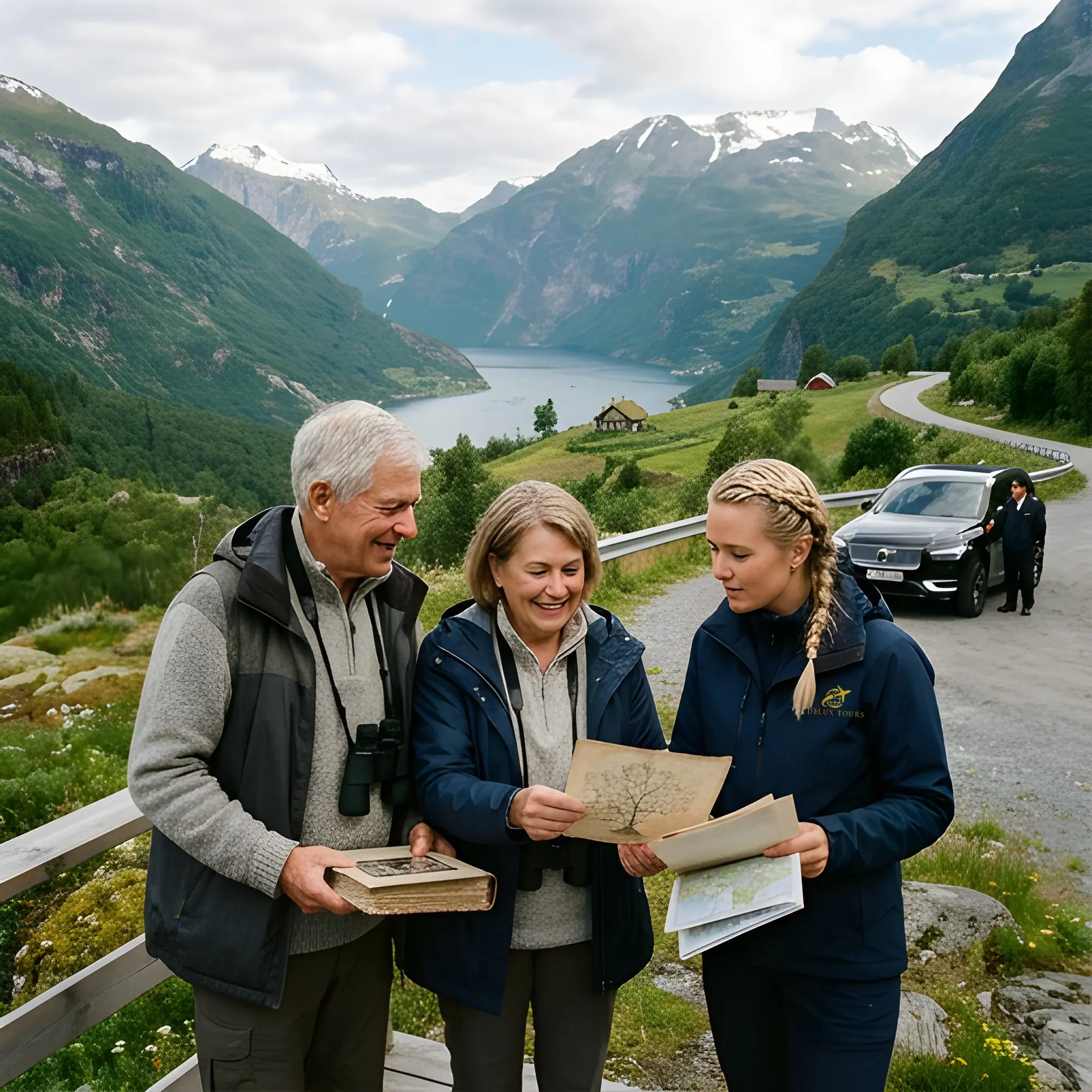
A Delux Tours guide shows a family an old family-tree drawing and a map at a viewpoint above a Norwegian fjord
Norwegian ancestry tour

Did your family come from Norway?

You are far from alone. In the century after 1825, about 800,000 Norwegians emigrated, most of them to the United States. Measured against its population, Norway lost a larger share of its people to emigration than any other European country except Ireland.

It began on 4 July 1825, when the sloop Restauration left Stavanger with 52 people on board and reached New York on 9 October. Then came the great waves: 1866–1873, 1879–1893 and the first decade of the 1900s, with a smaller wave again in the 1920s. In the peak year of 1882 alone, almost 29,000 people left Norway.

Most settled in the American Midwest: Minnesota, Wisconsin, North Dakota, Iowa and Illinois, and later on the Pacific coast in Washington. But Norwegians also built new lives far beyond the United States:

  • Canada — especially the Prairies, and in larger numbers in the 1920s, when the United States limited immigration.
  • Hawaii — in 1881, 613 Norwegians arrived on the ships Beta and Musca from Drammen to work on the sugar plantations.
  • New Zealand — Norsewood was founded as a Norwegian settlement in 1872.
  • South Africa — in 1882, 246 Norwegians, most from Ålesund and Sunnmøre, sailed on the Lapland to found Marburg in Natal.
  • Australia, South America and Britain — smaller but real Norwegian communities grew there too.

The Second World War was not a wave of emigration, but it scattered many Norwegians across the world. During the German occupation (1940–1945), about 50,000 Norwegians fled to Sweden and about 3,300 crossed the North Sea in small boats to Britain. Thousands of Norwegian seamen sailed in the Allied merchant fleet, and about 3,700 of them lost their lives. A Norwegian air-force training camp, "Little Norway", opened near Toronto in November 1940. Some of these men and women never moved home again: they married and built their lives abroad.

Today, nearly 4 million Americans and more than 460,000 Canadians report Norwegian ancestry. Perhaps you are one of them.

Sources: Store norske leksikon – Utvandring · Store norske leksikon – Englandsfarere · Store norske leksikon – Krigsseiler · nordics.info – Emigration from Norway · Norwegian Americans · Norwegian Canadians · Scandinavian migration to Hawaii · Marburg, South Africa · Norway in World War II

Norwegian genealogy trip

How it works

1

Send us your clues

Names, dates, places, old letters, photographs, a family Bible, a ship's name, a farm name someone once mentioned. Even a rough idea of the region helps. You send what you have, and we tell you honestly what is possible.

2

Roots Research

Our team works through the Norwegian records: national censuses, parish registers of baptisms, confirmations and marriages, emigration records from the ports, and local farm histories (bygdebøker). Norwegian names follow their own old rules: a family often took the name of the farm they lived on, and children's surnames came from their father's first name (Olsen, Olsdatter). So the same ancestor may appear under several names. We follow every one of them.

You receive a written Roots Report with the most likely farm and parish, the records we found with their archive references, a map, and a proposed route for your day. Before the day, you have a video call with your guide.

3

Roots Discovery Day

Your private driver and local guide, working as one team, take you to the places in your Roots Report. Your guide knows the area and how to find the right people: the local history society (historielag), the village museum, the parish, and, when they welcome it, the family who lives on the farm today. Any visit to a private farm is arranged with the owners in advance. Between the stops, you see the landscape your ancestors saw every day.

Find your ancestors' farm in Norway

A day you will carry home

You walk into the church where your great-great-grandmother was baptised. You stand at the edge of the fields your family farmed before they left. You hear the local dialect, see the fjord and the mountains they talked about for the rest of their lives, and understand why it was so hard to leave, and why they had to.

The result depends on how true and precise your clues are. We tell you honestly what the records show, and what they do not. We never invent a connection, and we never promise to find a specific house, grave or living relative. If our research cannot point to a home region, we tell you before you book the Roots Discovery Day.

Your clues

What to send us

  • Full names of your Norwegian ancestors, including any different spellings
  • Approximate years of birth, marriage, emigration and death
  • Any farm, parish, town or region names mentioned in the family
  • Where they settled, and when (country, state or province, town)
  • Copies of old letters, photographs, family Bible pages, obituaries or gravestone photos
  • Census entries from the USA (1900–1930) or Canada, which often show the year of immigration
  • Ship or port names, if known
  • DNA matches with people in Norway, if you have them
Included

What's included

  • Roots Research in Norwegian archives and records
  • Written Roots Report with archive references and a map
  • A video call with your guide before the day
  • A printed copy of your Roots Report, handed to you on the day
  • Private driver and car for 8 hours
  • Your own local guide for the whole day, who contacts local people and places for you in advance
  • Pickup and drop-off at your hotel
  • Visits to the parish church, the farm area and local places linked to your family, as in your Roots Report
  • Entrance tickets to museums and places on your route
  • All ferries and road tolls on the day
  • Water and local Norwegian snacks throughout the day
Not Included

Not included

  • Lunch (your guide recommends a good local place)
  • Personal expenses
  • Gratuities (optional)
Know Before You Go

Good to know

  • Everything on the day is included in the price. You only pay for your own lunch, personal expenses and optional gratuities.
  • We book the Roots Discovery Day only after the Roots Research, so you know what the day can show you before you plan it.
  • If you already know the exact farm or parish, tell us. Your research may be shorter.
  • Some places on your route may be private land. We visit them only with the owners' permission; otherwise we see them from the public road.
  • Norwegian records are written in Norwegian and old handwriting. Your guide explains what each record says.
  • In winter, some mountain roads close. We plan your route around it.
Roots Research from €960 · Roots Discovery Day from €2,850 per private group

up to 6 guests · 8 hours on the day

Start your roots journey →

100% private · Your own driver and guide · Honest research

Norwegian roots

Start your roots journey

Tell us what you know. We reply within 24 hours with an honest first view of what is possible.

You can send copies of documents and photos after we reply — we will tell you the safest way to do it.

Thank you.

Thank you. Your clues are on their way to us. We will reply within 24 hours.